





October is almost here. And for financial services firms across Chicago and the Midwest, Cybersecurity Awareness Month isn’t just a calendar reminder; it’s a pressure test.
Banks, credit unions, insurers, wealth managers, and fintechs sit on everything attackers want: money, identities, and deeply sensitive data. You operate under some of the strictest regulatory scrutiny in the country. And you’re held to a standard most industries never face: when a financial institution stumbles, it’s not just an outage, it’s a breach of trust that can take years to rebuild.
So this October 2026, it’s worth asking a harder question: is your current security approach actually built for the threats you face today? For most firms, the honest answer is not yet. Here’s why and what a better approach looks like.
Persistent exposure

Financial services has always been the crown jewel for cybercriminals. The motivation is simple: the payoff is bigger here than almost anywhere else. A single compromised account, a single exposed dataset, or a single fraudulent transaction can be worth far more than a typical retail breach.
But the targeting has intensified. Attackers aren’t just opportunistic anymore. They’re patient, well-funded, and increasingly organized. Ransomware crews, state-sponsored groups, and fraud rings all view financial institutions as strategic targets: not just for the money you hold, but for the access you provide to interconnected systems, payment rails, and customer networks.
Regulators know this. That’s why financial services firms operate under frameworks like GLBA, NYDFS Part 500, SEC cybersecurity rules, and PCI DSS. These aren’t checkboxes. They reflect a reality: the data you hold, the access you grant, and the systems you run are all high-stakes assets. Protecting them deserves more than a once-a-year awareness campaign.
Measurable risk
The threat landscape has shifted. The old perimeter, e.g., firewalls, VPNs, and a strong password policy, no longer holds. Today’s attacks target the seams between people, data, and systems. And the numbers tell the story clearly.
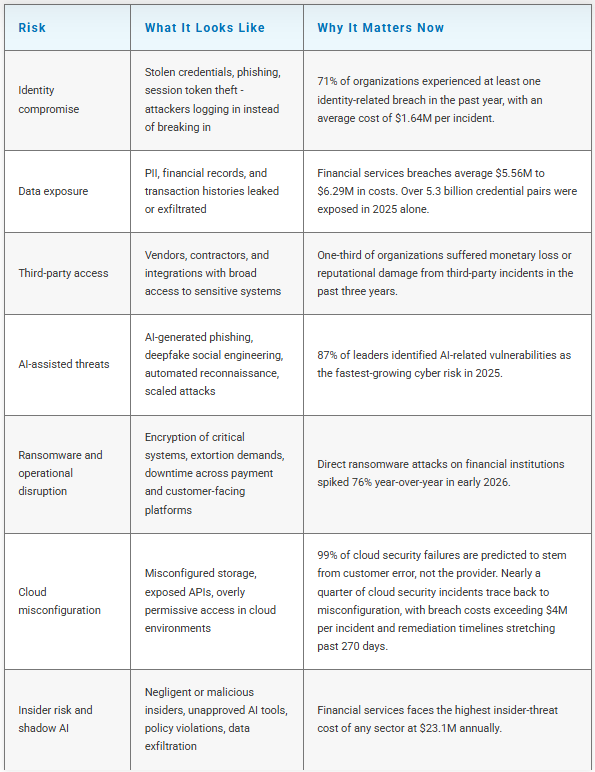
| Risk | What it looks like | Why it matters now |
|---|---|---|
| Identity compromise | Stolen credentials, phishing, session token theft - attackers logging in instead of breaking in | 71% of organizations experienced at least one identity-related breach in the past year, with an average cost of $1.64M per incident. |
| Data exposure | PII, financial records, and transaction histories leaked or exfiltrated | Financial services breaches average $5.56M to $6.29M in costs. Over 5.3 billion credential pairs were exposed in 2025 alone. |
| Third-party access | Vendors, contractors, and integrations with broad access to sensitive systems | One-third of organizations suffered monetary loss or reputational damage from third-party incidents in the past three years. |
| AI-assisted threats | AI-generated phishing, deepfake social engineering, automated reconnaissance, scaled attacks | 87% of leaders identified AI-related vulnerabilities as the fastest-growing cyber risk in 2025. |
| Ransomware and operational disruption | Encryption of critical systems, extortion demands, downtime across payment and customer-facing platforms | Direct ransomware attacks on financial institutions spiked 76% year-over-year in early 2026. |
| Cloud misconfiguration | Misconfigured storage, exposed APIs, overly permissive access in cloud environments | 99% of cloud security failures are predicted to stem from customer error, not the provider. Nearly a quarter of cloud security incidents trace back to misconfiguration, with breach costs exceeding $4M per incident and remediation timelines stretching past 270 days. |
| Insider risk and shadow AI | Negligent or malicious insiders, unapproved AI tools, policy violations, data exfiltration | Financial services faces the highest insider-threat cost of any sector at $23.1M annually. |
Hidden gaps
Most financial services firms have invested in security. However, many are still defending a model of work that no longer exists, and the gaps look different depending on where you sit in the industry.
- Retail banks and credit unions often rely on perimeter-first thinking, i.e., firewalls and VPNs that assume a clear boundary between "inside" and "outside". That boundary dissolved when branches went hybrid, mobile banking became the norm, and third parties started accessing systems from everywhere. A perimeter that can't see identity, device health, or data sensitivity is a perimeter that's already been bypassed.
- Wealth and asset managers tend to accumulate fragmented tooling such as one tool for endpoints, another for email, another for identity, another for logs. Each generates alerts. Few talk to each other. The result is alert fatigue, blind spots, and slow response when something real happens across a high-net-worth client portfolio.
- Insurers frequently struggle with reactive incident response; businesses treat security as a break-fix function where something happens and the team reacts. In a sector handling claims data, policyholder PII, and underwriting models, that lag between detection and response is measured in financial and reputational loss.
- Fintechs and payment processors face weak identity governance. Access rights accumulate as teams scale fast: people change roles, contractors come and go, and permissions are rarely revoked as promptly as they're granted. That sprawl creates exactly the kind of gaps attackers look for in fast-growing, API-heavy environments.
- Across all sub-sectors, limited visibility into third-party activity remains a shared blind spot. Vendor access is often granted broadly and reviewed rarely. Firms know third-party risk exists, but few have continuous monitoring in place to catch when a partner's environment becomes a liability.
Practical resilience

Cyber resilience isn’t just about preventing attacks. It’s about staying secure, compliant, and operational even when threats get through. Here’s what that looks like in practice:
- Layer your controls. Identity verification, device compliance, data protection, and network controls work together; an attacker who steals a credential still hits a wall when the device isn't compliant or the access pattern looks off.
- See your full environment. Consolidate signals across identities, endpoints, email, cloud apps, and data into a single view. Faster detection, fewer blind spots, and the ability to connect the dots between events that point solutions would miss.
- Make identity your primary control plane. Strong authentication, conditional access based on risk signals, and continuous governance of who has access to what - not just at onboarding, but throughout the lifecycle.
- Govern third-party access continuously. Know where your data lives, who can reach it, and whether that access is still justified. Regular access reviews, least-privilege defaults, and continuous monitoring of vendor activity close the gaps attackers exploit.
- Respond around the clock. A 24/7 Security Operations Center ensures threats are caught and contained fast, not when someone gets around to reviewing alerts. In financial services, where minutes matter, continuous detection and response is what separates resilience from recovery.
- Automate to scale your team. Automation for log collection, alert triage, and common response actions cuts the noise, reduces false positives, and lets your team focus on the threats that actually matter.
- Tie it all to governance. When security, compliance, and business continuity are aligned, you're not just protecting data - you're protecting the trust your customers and regulators expect.
Partnered defense
Did you know that a global financial services client of iwx secured 100% of the IT environment within four weeks, achieved a 98% reduction in false positives, and delivered an average 15-minute response time through its SOC – all while strengthening compliance with regulatory standards?
As a Microsoft Solutions Partner and Managed Security Service Provider, iwx can provide unified visibility, detection, and response across your entire environment.
This coming October, don’t just raise awareness. Build resilience. iwx can help you strengthen your firm’s cyber resilience.
References:
1. World Economic Forum, Global Cybersecurity Outlook 2026
2. EY, Cybersecurity leaders investing in AI and agentic defenses (2026)
3. KPMG, 2026 Global Third-Party Risk Management Survey
4. Gartner, Information Security, 2023–2029, 3Q25 Update & 2Q26 Forecast
5. McKinsey & Company / Institute of International Finance (Derisking emerging technologies in financial services)
6. IBM, Cost of a Data Breach Report 2026
7. Sophos, The State of Ransomware in Financial Services 2025
8. Black Kite, 2026 State of Financial Services Report
9. Ponemon Institute / DTEX, 2026 Cost of Insider Risks: Global
10. Thales, 2026 Data Threat Report (Financial Services Edition)
11. Sophos, The State of Identity Security 2026
12. Double Octopus, 2026 State of Identity Security in Financial Organizations
13. SpyCloud, 2026 Identity Exposure Report
14. IMF, Artificial Intelligence and Cybersecurity in the Financial Sector