





Last year, the question was: “Are employees using AI?” Today, a better question might be: “Do we know which AI tools employees are using and whether they’re using them safely?”
Once you know AI is being used across the business, how do you create a framework that encourages innovation while protecting data, maintaining accountability, and reducing risk?
That’s where safe AI begins.
What successful AI Adoption looks like

Some organizations are making faster progress with AI than others. Not because they’ve rolled out more tools. Not because they’ve invested more money. And not because they’ve solved every governance challenge. The difference is that they’re approaching AI differently.
They focus on decisions, not tools
AI can help summarize information, analyze trends, draft content, and surface recommendations. But successful organizations understand that the goal isn’t simply adopting AI. It’s improving the quality, consistency, and speed of decision-making while maintaining accountability.
They trust guardrails more than they trust AI
Businesses don’t scale AI because they believe AI is perfect. They scale AI because they trust the guardrails around it. Clear policies, sensible oversight, approved tools, and practical governance create confidence.
They keep humans in the loop
Safe AI doesn’t remove people from the process. It helps people make better decisions, faster. Whether it’s reviewing customer communications, financial forecasts, legal documents, or operational recommendations, human accountability remains essential.
They build on what they already have
Many businesses already have pieces of an AI governance framework in place. They have:
- Security controls
- Employee training programs
- Data protection policies
- Compliance requirements
- Technology standards
The next step often isn’t building something entirely new. It’s connecting those pieces into a practical framework that supports AI adoption.
They know visibility is only the beginning
Visibility matters. You can’t govern what you can’t see. But discovering shadow AI isn’t the finish line. It’s the starting point.
The real opportunity comes from creating an environment where employees can use AI safely, consistently, and responsibly while still capturing the productivity benefits that made them use AI in the first place.
Which brings us to the three areas every organization should focus on.
A practical framework for moving from shadow AI to safe AI
Organizations making the most progress typically focus on three connected areas: policy, training, and technology.
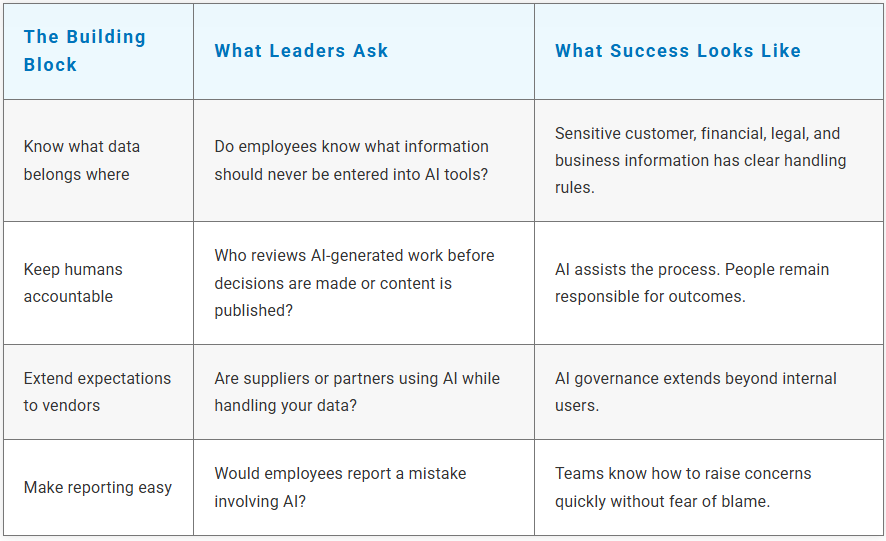
Policy: Establish what responsible AI use looks like
| The building block | What leaders ask | What success looks like |
|---|---|---|
| Know what data belongs where | Do employees know what information should never be entered into AI tools? | Sensitive customer, financial, legal, and business information has clear handling rules. |
| Keep humans accountable | Who reviews AI-generated work before decisions are made or content is published? | AI assists the process. People remain responsible for outcomes. |
| Extend expectations to vendors | Are suppliers or partners using AI while handling your data? | AI governance extends beyond internal users. |
| Make reporting easy | Would employees report a mistake involving AI? | Teams know how to raise concerns quickly without fear of blame. |
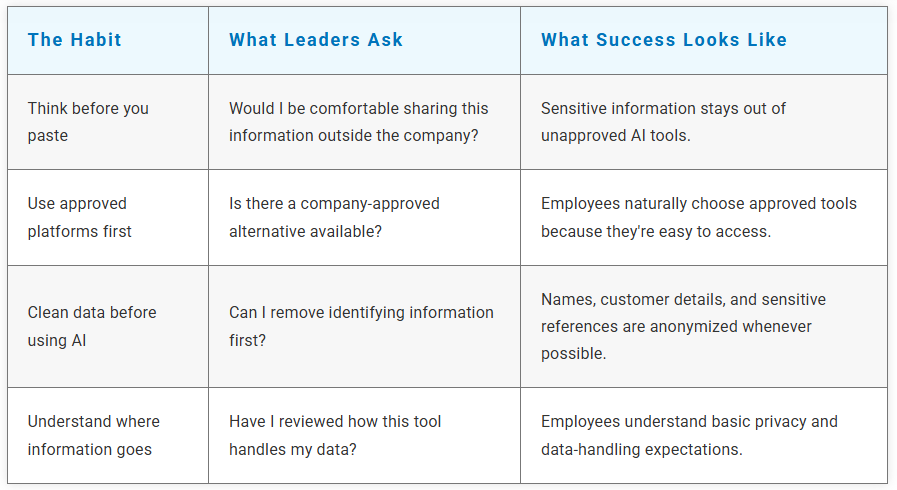
Training: Help employees make smarter decisions
| The habit | What leaders ask | What success looks like |
|---|---|---|
| Think before you paste | Would I be comfortable sharing this information outside the company? | Sensitive information stays out of unapproved AI tools. |
| Use approved platforms first | Is there a company-approved alternative available? | Employees naturally choose approved tools because they're easy to access. |
| Clean data before using AI | Can I remove identifying information first? | Names, customer details, and sensitive references are anonymized whenever possible. |
| Understand where information goes | Have I reviewed how this tool handles my data? | Employees understand basic privacy and data-handling expectations. |
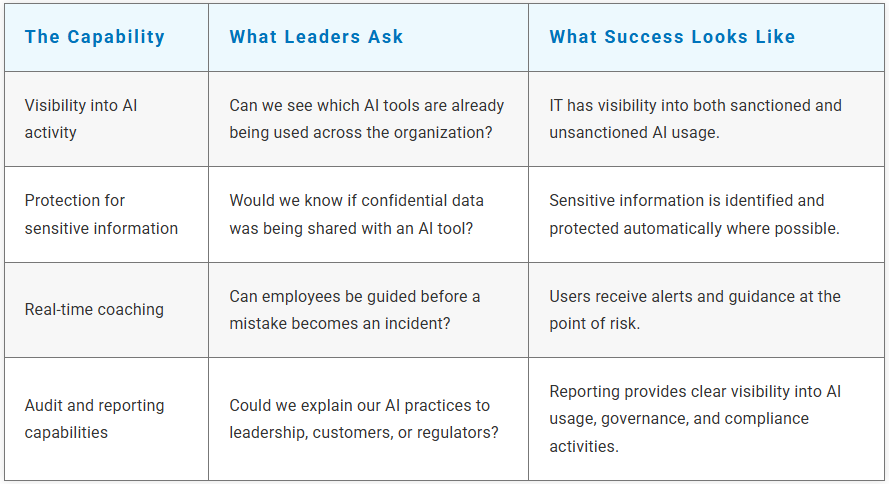
Technology: Create guardrails that support both productivity and security
| The capability | What leaders ask | What success looks like |
|---|---|---|
| Visibility into AI activity | Can we see which AI tools are already being used across the organization? | IT has visibility into both sanctioned and unsanctioned AI usage. |
| Protection for sensitive information | Would we know if confidential data was being shared with an AI tool? | Sensitive information is identified and protected automatically where possible. |
| Real-time coaching | Can employees be guided before a mistake becomes an incident? | Users receive alerts and guidance at the point of risk. |
| Audit and reporting capabilities | Could we explain our AI practices to leadership, customers, or regulators? | Reporting provides clear visibility into AI usage, governance, and compliance activities. |
Moving from shadow AI to safe AI

Effective AI adoption starts with visibility. The goal is to create a framework that transforms it into something secure, governed, and valuable for the business. As a Microsoft Partner serving businesses across Chicago and the Midwest, we help organizations understand their AI landscape and know how to use it safely, confidently, and intentionally.