




Marketing agencies are built for speed, with the kind of flexibility that keeps projects moving. But it can also make cybersecurity surprisingly complicated.
A designer needs access to a client’s brand assets. A freelancer gets added to a campaign halfway through. The paid media team connects another platform. Someone finds an AI tool that can get three hours of work done in 20 minutes. And the client needs the campaign live by Friday.
The challenge isn’t simply stopping phishing emails. You have to ask: Who has access to what? Which apps are connected? Where does client information live, and where does it go? Does anyone have visibility over the whole environment?
Why are marketing agencies attractive cyber targets?

Agency work moves fast, and so does access. A typical environment can involve:
- Client systems your team doesn’t own
- Freelancers with short term access
- SaaS tools added project by project
- Shared files moving inside and outside the agency
- Multiple identities connected to valuable client accounts
- AI tools entering workflows faster than policies do
Put those together and cybersecurity becomes less about protecting one network and more about keeping track of people, permissions, data and tools as they change.
Three cyber shifts worth a closer look
If phishing is only part of the picture, what else deserves your attention? Three shifts stand out in the 2026 cybersecurity landscape:
1
AI is changing both sides of the equation
In 2026 research, 94% of respondents said they expect AI to be the most significant driver of change in cybersecurity, while 87% identified AI related vulnerabilities as the fastest growing cyber risk over 2025. That creates an interesting tradeoff: AI can help teams work faster while changing the risks that come with the work.
2
Fraud is getting harder to spot
Cyber enabled fraud and phishing increased according to 77% of respondents, with phishing, payment fraud and identity theft among the three most commonly reported attack types. When unusual requests are normal, “Does this look legitimate?” becomes a much more interesting security question. That puts more weight on strong identity controls and verification, rather than expecting people to spot every convincing fake on sight.
3
Your security perimeter includes other people’s tools
Freelancers, contractors, clients and SaaS platforms can all become part of an agency’s working environment. That doesn’t mean treating every freelancer, client or SaaS platform as a problem. It means understanding what has access to agency and client information, keeping permissions appropriate and making sure temporary access actually stays temporary.
When AI tools join the agency ecosystem
Three questions worth asking about AI usage inside your marketing agency:
Do you actually know which AI tools your team is using?
Not just the tools the agency officially pays for. Think about browser based AI tools, free accounts, meeting assistants, creative platforms and AI features being added to SaaS products your team already uses.
What information is finding its way into those tools?
There’s a meaningful difference between asking AI for headline ideas and giving it client information, campaign data, internal documents or other business sensitive material.
What happens when an AI tool connects to the rest of your environment?
The conversation changes again when an app isn’t simply receiving a prompt, but is connected to company identities, files, email or other systems. Banning every new tool isn’t particularly realistic for an agency where experimentation is part of the job. A better starting point is knowing what’s being used, what it can access and what information is appropriate to share with it.
What should marketing agencies actually secure?
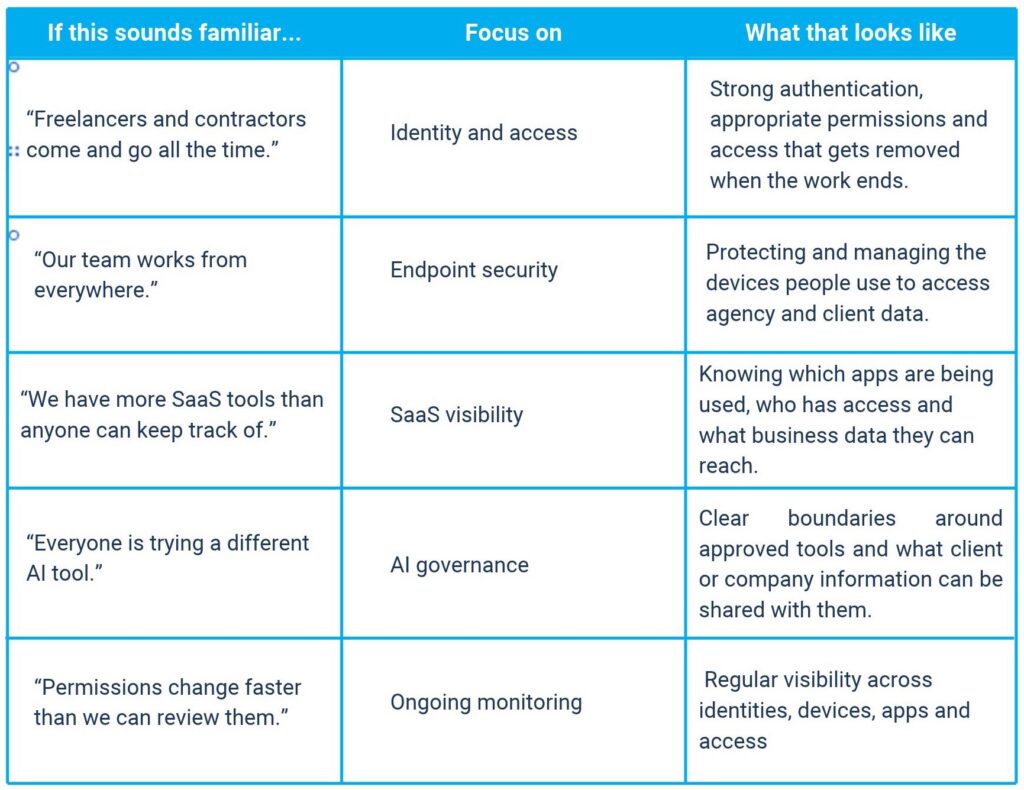
You don’t necessarily need more security tools. You need to know where your gaps are and make security fit the way your agency actually works.
Security that gets out of your team’s way

Agency security has to account for client deadlines, changing project teams, contractors and temporary access.
That means knowing who has access, keeping your Microsoft environment governed, removing access when it’s no longer needed and being able to show clients that the right controls are in place.
You don’t need to guess where the gaps are. A Security & Compliance Readiness Assessment gives you a clearer starting point for understanding your current environment, identifying where attention is needed and prioritizing what comes next.
Start your security & compliance readiness assessment
Sources:
- Global Cybersecurity Outlook 2026: The Trends Reshaping Cybersecurity
- Global Cybersecurity Outlook 2026: AI is reshaping risk, accelerating both offence and defence