





If you run a business with 50 to 500 people in Chicago or the broader Midwest, chances are your Microsoft 365 subscription is costing more than it should and delivering less than it could.
This playbook walks through how to get more value from Microsoft 365 in 2026 – cutting waste, tightening security, and getting ready for AI without buying a pile of new things you don’t need.
A few pressures are shaping how businesses spend on IT right now:
- 450 million commercial Microsoft 365. Every licensing cycle, the bill gets bigger. Yet most businesses are still paying for capabilities they've never turned on.
- 54% of businesses lack IT capacity. Most SMBs run on fewer than three dedicated IT staff, yet those same teams are now expected to manage security, compliance, and AI governance simultaneously.
- 90% of successful cyberattacks start with phishing (and insurers know it). Cyber insurance renewals in 2025–2026 increasingly require stronger identity and access controls as a condition of coverage.
- Microsoft 365 Copilot surpassed 30 million paid seats in FY26 Q4. Microsoft's own 2026 Work Trend Index shows shadow AI use is broader and largely untracked.
- 31% of breaches start with software vulnerabilities. Businesses that haven't reviewed their patch management, update policies, and exposure points are carrying more risk than they realize.
Are you getting what you're paying for in Microsoft 365?

Start by asking a few honest questions about what you’re actually paying for:
-
Are you still paying for seats that belong to people who left months ago?
Inactive licenses are one of the most common and most avoidable sources of wasted spend. -
How many accounts in your tenant were created for contractors, shared mailboxes, or old test users that nobody ever cleaned up?
Duplicate accounts quietly rack up costs with no one noticing. -
Are your employees all on the same plan, regardless of what they actually do?
Paying premium-tier pricing for users who only need the basics is money left on the table. -
Are you paying for Zoom, Dropbox, or Slack on top of Teams, OneDrive, and SharePoint?
If Microsoft 365 already covers the job, a duplicate subscription is a duplicate expense. -
How much advanced security protection are you paying for that you've never actually switched on?
Many businesses buy extra security products to fill gaps that their existing Microsoft licensing already covers.
Match your 365 license to the role
One of the biggest sources of waste is treating every employee the same, and paying twice for tools Microsoft 365 already covers. The two tables below help you fix both.
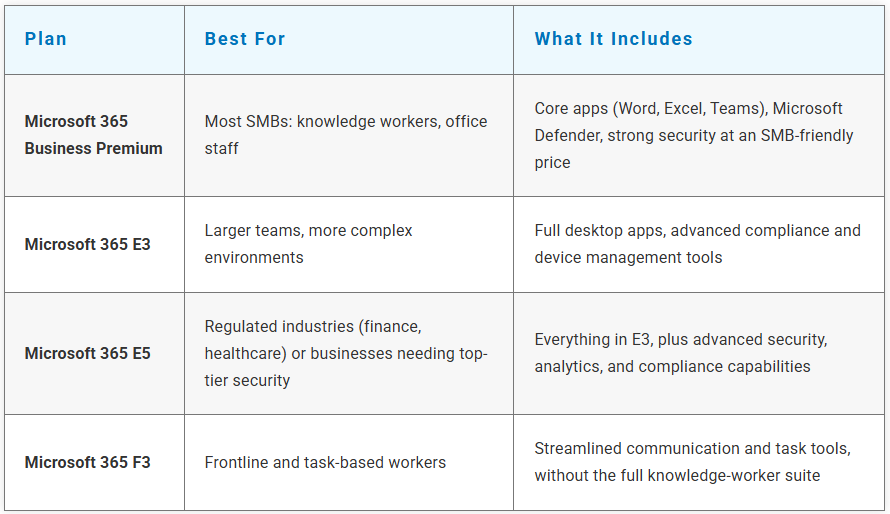
Which Microsoft 365 plan fits which employee?
| Plan | Best for | What it includes |
|---|---|---|
| Microsoft 365 Business Premium | Most SMBs: knowledge workers, office staff | Core apps (Word, Excel, Teams), Microsoft Defender, strong security at an SMB-friendly price |
| Microsoft 365 E3 | Larger teams, more complex environments | Full desktop apps, advanced compliance and device management tools |
| Microsoft 365 E5 | Regulated industries (finance, healthcare) or businesses needing top-tier security | Everything in E3, plus advanced security, analytics, and compliance capabilities |
| Microsoft 365 F3 | Frontline and task-based workers | Streamlined communication and task tools, without the full knowledge-worker suite |
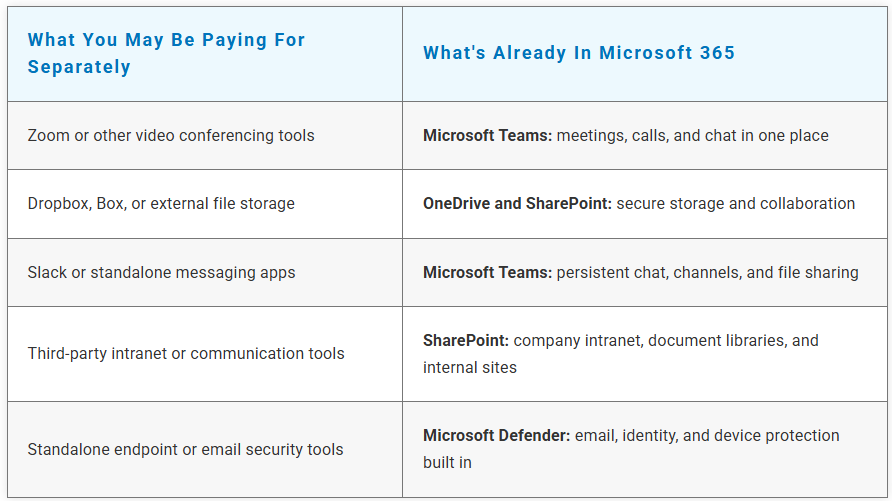
What does Microsoft 365 already cover and what can you cancel?
| What you may be paying for separately | What's already in Microsoft 365 |
|---|---|
| Zoom or other video conferencing tools | Microsoft Teams: meetings, calls, and chat in one place |
| Dropbox, Box, or external file storage | OneDrive and SharePoint: secure storage and collaboration |
| Slack or standalone messaging apps | Microsoft Teams: persistent chat, channels, and file sharing |
| Third-party intranet or communication tools | SharePoint: company intranet, document libraries, and internal sites |
| Standalone endpoint or email security tools | Microsoft Defender: email, identity, and device protection built in |
AI readiness: An essential business spend in 2026
In 2026, maximizing Microsoft 365 value isn’t just about cutting waste; it’s about making sure your environment is ready to support AI securely and deliberately.
Most employees aren’t waiting for an official AI policy. They’re already using tools they found themselves: pasting client data into consumer AI apps, running sensitive documents through free summarizers, or subscribing to AI tools on a personal card. This is shadow AI, and it creates three compounding problems: data lands in systems your IT team can’t see or control, your governance posture weakens with every unsanctioned tool, and you end up paying twice when those tools duplicate what Microsoft 365 already offers.
- Create an approved path for AI use. If employees have no clear way to request or evaluate AI tools, they will use whatever is easiest. A lightweight approval process keeps adoption visible and reduces shadow AI.
- Set clear data boundaries. Define what information can be entered into AI tools, what requires review, and what should never leave your controlled environment. Without that, one careless prompt can create a security or compliance issue.
- Review what Microsoft 365 already covers. Before buying another AI product, check whether the use case is already supported within your Microsoft environment. Overlapping tools increase cost, complexity, and governance risk.
- Align AI access to role and risk. Not every employee needs the same AI capabilities or the same data access. Tie AI usage to job function, sensitivity of information, and existing identity controls.
- Assign ownership and review usage regularly. AI adoption needs an owner - someone responsible for policy, tool approvals, exception handling, and periodic review of what teams are actually using.
Turning Microsoft 365 into a genuine advantage

Doing all of this while running a business is a lot to take on, especially with a lean team. As a Microsoft Partner and managed IT provider serving Chicago and the Midwest, iwx helps businesses like yours cut wasted spend, tighten security using the tools you already own, and prepare for AI-era operations without the guesswork. Curious where your quick wins are? Book a free consultation with iwx, and build a smarter Microsoft 365 playbook for 2026.